Poseidon Roofing & Waterproofing
  • Services
    • Commercial & Industrial Roofing
    • Roof Repair
    • Waterproofing
    • Emergency Roof Repair
  • Roof Systems
    • Commercial Flat Roofs
    • Shingle
    • Metal
    • Clay Tile
    • Concrete Tile
    • Cedar Shake
  • Areas We Serve
    • Orlando
    • Fort Lauderdale
    • Tampa
    • Fort Myers
  • Industries
    • Hospitality
    • Warehousing & Distribution
    • Medical Buildings
  • About Us
    • Projects
    • Partners
    • Careers
    • Blog
  • Contact
  • Menu Menu

Types of Commercial Flat Roofs: Choosing the Right System for Your Florida Property

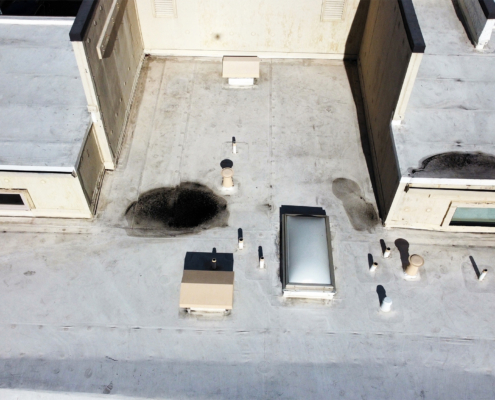
Your roof isn’t failing. It’s telling you something. Whether it’s a slow leak after every heavy rain, worn membrane seams at the penetrations, or deteriorating material around equipment curbs, the question on your desk is the same: what type of system makes sense here, and what will actually hold up? The types of commercial flat roofs available in Florida aren’t interchangeable, and your building type, the condition of what’s already up there, and the specific demands of Florida’s climate all factor into which system delivers the best long-term return.
What Florida’s Climate Demands From a Flat Roofing System

Not every commercial flat roofing system is built for the same environment. Florida presents a combination of stressors that accelerate wear faster than most other U.S. markets, and understanding them is the starting point for any honest system comparison.

UV Exposure and Thermal Load

Florida’s year-round solar intensity breaks down certain flat roof materials faster than manufacturers’ spec sheets suggest. Membranes that perform well in northern climates can blister, crack, or lose reflectivity in a fraction of the time here when exposed to sustained UV. Thermal expansion and contraction across Florida’s temperature swings also stress field seams and transitions, which is where failures almost always begin.

Wind Uplift, Humidity, and Salt Air

Florida building codes impose strict wind uplift requirements on any roofing system, which affects how certain flat roof materials can be attached. High ambient humidity creates conditions where trapped moisture accelerates substrate rot long before a leak shows up on the interior. In coastal markets—Fort Lauderdale, Fort Myers, and parts of Orlando’s tourism corridor—salt air degrades metal fasteners and adhesive bonds over time, making system compatibility with the local environment a real selection factor, not an afterthought.

The Three Main Types of Commercial Flat Roofs

The types of commercial roofing systems used on low-slope buildings fall into three primary categories. Each has distinct performance characteristics, ideal applications, and cost profiles. Knowing how they differ is what makes the difference between a sound investment and a system you’re revisiting in ten years.

Single-Ply Membrane Systems

Single-ply membranes, specifically TPO, PVC, and EPDM, are the most widely installed flat roof membrane type in commercial construction today. TPO and PVC are thermoplastic systems with heat-welded seams that are often stronger than the membrane itself. PVC carries a natural resistance to chemicals and oils, making it a common choice for restaurant rooftops and food-adjacent industrial applications. EPDM performs well on UV resistance but can be more vulnerable at seams and terminations if installation quality isn’t airtight. As a starting point for commercial flat roofing on budget-conscious projects, single-ply systems are hard to beat.

Modified Bitumen Systems

Modified bitumen is an asphalt-based system reinforced with polyester or fiberglass and modified with APP or SBS compounds for flexibility and resilience. It’s installed in multiple plies, and that layering creates built-in redundancy. Modified bitumen is particularly suited to roofs that carry heavy foot traffic or dense mechanical equipment, where puncture resistance matters more than weight savings. The multi-ply construction also performs well at transitions and flashings, where single-ply systems can be more exposed. The tradeoff is that installation is more labor-intensive and the material is heavier, which matters on older structures where load capacity is a concern.

Liquid-Applied Roofing Systems

Liquid-applied systems are applied as a fluid and cure into a seamless, monolithic membrane with no seams, no laps, and no mechanical fasteners. That eliminates the most common failure points found in other flat roof materials. These systems are particularly effective on complex roof geometries: structures with multiple penetrations, equipment curbs, parapet walls, and transitions that make sheet-based systems difficult to detail cleanly. They’re also the preferred path for recover projects, where a sound existing substrate can be coated rather than torn off. Poseidon’s waterproofing and liquid-applied solutions, which include certified systems from Sika/Sarnafil and Soprema, also encompass ceramic insulative coatings—a radiant heat barrier worth asking about if you’re managing energy costs across multiple facilities.

Comparing the Types of Commercial Flat Roofs at a Glance

System
Seam Risk
Best For
Florida Advantage
Warranty Ceiling
TPO/PVC Single-Ply Low (welded seams) Standard commercial roofs UV-reflective, energy efficient 15–30 years
EPDM Moderate Low-traffic, mechanicals UV resistant flat roof membrane 10-20 years
Modified Bitumen Low (multi-ply) High-traffic, equipment-heavy roofs Built-in redundancy at transitions 10-20 years
Liquid-Applied None (seamless) Complex geometries, recovers Zero penetration failure points 15-25 years

Getting the system right starts with someone walking the roof with you, not a quote over the phone. Poseidon evaluates your current flat roofing conditions and recommends the right path forward, not the most expensive one.

Explore Our Flat Roof Services

Matching the Right System to Your Building

The table above is a useful framework, but the right choice for your property comes down to two factors that don’t appear in any spec sheet.

The Condition of What’s Already Up There

If your current substrate is structurally sound with no saturated insulation, significant delamination, or ponding damage, a recover may be on the table. Several types of commercial flat roofs, particularly liquid-applied systems, can be installed over an existing membrane and extend service life by 15 to 25 years at a fraction of full replacement cost. Poseidon conducts core cuts and substrate evaluations before any recommendation is made, because the cost difference between a recover and a full tear-off is significant enough to get right before a scope of work is written.

How the Building Functions Day to Day

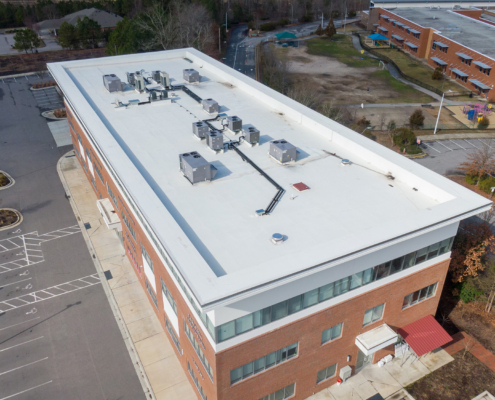
A hotel with accessible roof decks and constant maintenance traffic has different requirements than a refrigerated distribution facility. Commercial and industrial roofing decisions need to account for foot traffic frequency, the density of mechanical penetrations, tenant or guest proximity to the roof structure below, and the operational risk of any installation-phase downtime. These details directly shape which of the types of commercial flat roofs is appropriate and how work should be phased to protect business continuity.

The Recover Option: More Available Than Most Property Managers Realize

Full tear-off is the default assumption in most roofing conversations. It doesn’t have to be. When a roof is evaluated before it reaches the point of structural damage or saturated insulation, a liquid-applied or single-ply overlay can deliver a new service life without the debris, the dumpsters, or the extended construction window. The catch is timing: the recover option closes once the damage crosses a certain threshold, which is exactly why routine inspections have real financial value. Catching your flat roof at the right point in its lifecycle is where a consultative site evaluation makes the biggest difference.

The Right Flat Roof Starts With the Right Conversation

Commercial flat roofing isn’t a category where one system wins across every application. The types of commercial flat roofs that hold up in Florida all have real strengths. What separates a sound investment from a costly mistake is the quality of the assessment that precedes the installation.

Poseidon approaches every project as a consultative engagement first. That means an honest evaluation of your current substrate, a clear explanation of your options at multiple price points, and a recommendation built around your building’s actual demands. If a recover is viable, you’ll hear it. If a full replacement is the right call, we’ll show you exactly why. Reach out to start that conversation.

Share This Post

  • Share on Facebook
  • Share on X
  • Share on WhatsApp
  • Share on Pinterest
  • Share on LinkedIn
  • Share on Tumblr
  • Share on Vk
  • Share on Reddit
  • Share by Mail

More Like This

A Pre Season Storm Damage Roof Inspection Checklist For Florida Commercial Properties

A Pre-Season Storm Damage Roof Inspection Checklist for Florida Commercial Properties

Commercial Roofing, Roof Repair
https://www.poseidonsales.com/wp-content/uploads/2026/08/A-Pre-Season-Storm-Damage-Roof-Inspection-Checklist-for-Florida-Commercial-Properties.jpg 1248 2000 Abstrakt Marketing /wp-content/uploads/2025/05/Poseidon-Logo.jpg Abstrakt Marketing2026-08-20 11:46:572026-08-20 11:51:57A Pre-Season Storm Damage Roof Inspection Checklist for Florida Commercial Properties
Drone Photos Of Tpo Commercial & Residential Roofing Building

40- Year Recertification in Florida: What Condo and Commercial Property Owners Need to Know About Their Roof

Commercial Roofing, Contractor Credibility
https://www.poseidonsales.com/wp-content/uploads/2025/05/Drone-Photos-of-TPO-Commercial-Residential-Roofing-Building.jpg 1250 2000 Abstrakt Marketing /wp-content/uploads/2025/05/Poseidon-Logo.jpg Abstrakt Marketing2026-07-13 15:27:532026-07-13 15:28:0140- Year Recertification in Florida: What Condo and Commercial Property Owners Need to Know About Their Roof

Categories

  • Commercial Roofing
  • Contractor Credibility
  • Roof Repair
  • Roof Systems
Poseidon Logo

Our Roof Types

Commercial Flat Roofs

Shingle

Metal

Clay Tile

Concrete Tile

Cedar Shake

What We Do

Commercial and Industrial Roofing

Roof Repair

Waterproofing

Emergency Roof Repair

Contact Us

3471 High Ridge Road
Boynton Beach, FL 33426

202-831-3200

[email protected]

Website by Abstrakt Marketing Group ©
  • Privacy Policy
  • Sitemap
Scroll to top Scroll to top Scroll to top

This site uses cookies. By continuing to browse the site, you are agreeing to our use of cookies.

AcceptLearn more

Cookie and Privacy Settings


How we use cookies

We may request cookies to be set on your device. We use cookies to let us know when you visit our websites, how you interact with us, to enrich your user experience, and to customize your relationship with our website.

Click on the different category headings to find out more. You can also change some of your preferences. Note that blocking some types of cookies may impact your experience on our websites and the services we are able to offer.

Essential Website Cookies

These cookies are strictly necessary to provide you with services available through our website and to use some of its features.

Because these cookies are strictly necessary to deliver the website, refusing them will have impact how our site functions. You always can block or delete cookies by changing your browser settings and force blocking all cookies on this website. But this will always prompt you to accept/refuse cookies when revisiting our site.

We fully respect if you want to refuse cookies but to avoid asking you again and again kindly allow us to store a cookie for that. You are free to opt out any time or opt in for other cookies to get a better experience. If you refuse cookies we will remove all set cookies in our domain.

We provide you with a list of stored cookies on your computer in our domain so you can check what we stored. Due to security reasons we are not able to show or modify cookies from other domains. You can check these in your browser security settings.

Other external services

We also use different external services like Google Webfonts, Google Maps, and external Video providers. Since these providers may collect personal data like your IP address we allow you to block them here. Please be aware that this might heavily reduce the functionality and appearance of our site. Changes will take effect once you reload the page.

Google Webfont Settings:

Google Map Settings:

Google reCaptcha Settings:

Vimeo and Youtube video embeds:

Accept settingsHide notification only
